Introduction
Spinal cord stimulation is one of the most expensive and clinically complex interventions in pain management — and one of the most disputed in litigation. A single SCS system can generate tens of thousands of dollars in initial implant costs and tens of thousands more in projected future expenses: battery replacements, programming visits, revisions, and downstream procedures. For every dollar of SCS cost in a damages case, there is a clinical question beneath it: was this necessary?
This article explains how a board-certified pain management physician evaluates medical necessity for spinal cord stimulation in litigation — from the initial candidacy determination through trial documentation, permanent implantation, and the full spectrum of device-related disputes that arise in personal injury and malpractice cases. It is written for plaintiff attorneys, defense attorneys, and insurance counsel who need to understand what the clinical standard requires, what the records must show, and where the expert analysis begins.
What Is Spinal Cord Stimulation?
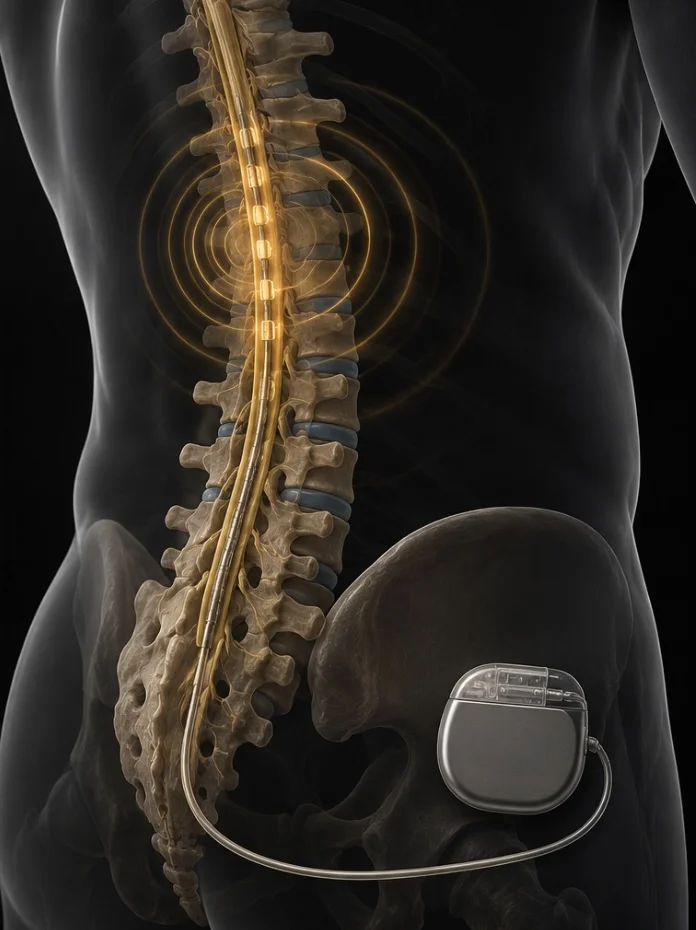
Spinal cord stimulation is a neuromodulation therapy in which an implanted device delivers low-level electrical impulses to the dorsal columns of the spinal cord to modulate pain signals before they reach the brain. The system consists of one or more electrode leads placed in the epidural space, a pulse generator (often called the implantable pulse generator or IPG) implanted subcutaneously — typically in the flank, buttock, or abdomen — and an external remote control that allows the patient to adjust stimulation parameters within physician-programmed limits.
Modern SCS systems have evolved substantially from earlier tonic stimulation devices. Current platforms offer burst stimulation, high-frequency stimulation (10 kHz), dorsal root ganglion stimulation, and closed-loop systems that automatically adjust output based on real-time feedback. These technological distinctions are clinically relevant in litigation when the type of device implanted affects battery longevity, programming complexity, MRI compatibility, and the basis for projected future care costs. See spinal cord stimulation expert review for a clinical overview of device types and their litigation implications.
SCS is categorically different from an injection or ablation procedure: it involves surgery, general or monitored anesthesia, hardware implantation, an external remote control system, lifelong follow-up programming, and eventual battery replacement or revision. The multi-step nature of the intervention — trial, then permanent implantation, then maintenance, then downstream events — creates multiple independent necessity questions that arise at different stages of litigation.
Common Conditions Treated With SCS
SCS is indicated for a defined set of chronic pain conditions that have failed conservative and interventional management. The most common clinically recognized indications in litigation — the ones most frequently at issue when damages or malpractice allegations involve SCS — are complex regional pain syndrome (CRPS), post-laminectomy syndrome, and peripheral neuropathic pain conditions including diabetic peripheral neuropathy and peripheral nerve injuries.
Other accepted indications include refractory angina, peripheral artery disease-related ischemic pain, and certain visceral pain syndromes. In litigation, the indication documented in the treating physician's record must be one that is recognized in published neuromodulation guidelines. An SCS implanted for chronic axial low back pain without radicular component or without a discrete diagnosis meeting guideline criteria is a common target for necessity challenge — not because SCS is ineffective, but because the clinical criteria for that specific indication require more rigorous documentation than was provided.
CRPS and SCS
Complex regional pain syndrome is one of the most compelling recognized indications for SCS, and early intervention with SCS is supported by published evidence for CRPS Type I and Type II. When CRPS is properly established using Budapest Criteria, SCS may be appropriate at an earlier stage of treatment escalation than it is for other conditions — particularly in CRPS Type I where the prognosis is better with earlier intervention.
In litigation, the CRPS-SCS nexus creates a compounded necessity analysis. The first layer is whether CRPS was correctly diagnosed — whether Budapest Criteria were met, whether the diagnosis was documented prospectively in the treating record, and whether the mechanism was sufficient to cause CRPS. The second layer is whether SCS was necessary given the documented CRPS severity, duration, and prior treatment course. Defense experts who contest the CRPS diagnosis simultaneously undermine the SCS indication, which is why plaintiff experts addressing SCS necessity in a CRPS case must ensure that both layers of the analysis are independently supported in the record.
The timing of SCS implantation relative to CRPS onset and prior treatment is also scrutinized. Early implantation before adequate conservative management — or late implantation after so much time has passed that the likelihood of meaningful response has diminished — can each be raised as a necessity or standard of care issue depending on the direction of the dispute.
Post-Laminectomy Syndrome and SCS
Post-laminectomy syndrome — persistent or recurrent pain following spinal surgery — is the most common indication for SCS in the United States, and it is one of the most frequently disputed in personal injury litigation. The clinical picture involves a patient who underwent lumbar or cervical surgery, achieved inadequate relief, and presents with continued axial and radicular pain often accompanied by functional limitation.
In a personal injury case with a surgical chain-of-causation, the expert must trace the entire sequence: accident caused injury, injury caused surgery, surgery caused post-laminectomy syndrome, post-laminectomy syndrome required SCS. Each link in that chain must be supported by the record. A defense expert who breaks any link — contesting that the accident caused the condition requiring surgery, or that the surgery was necessary, or that post-laminectomy syndrome is the accurate post-surgical diagnosis — disrupts the necessity foundation for SCS even if the implant itself was clinically well-executed.
SCS necessity for post-laminectomy syndrome also requires documented failure of post-surgical conservative management. A patient who proceeds from surgery to SCS without an adequate trial of post-surgical physical therapy, appropriate neuropathic pharmacology, and at least some interventional management at the symptomatic level does not have a complete necessity record. Experts evaluate this treatment course specifically when the SCS was implanted within a relatively short time following spinal surgery.
Post-Surgical Spine in Litigation Records
Attorneys reviewing SCS records will frequently encounter the phrase "failed back surgery syndrome" in operative reports, pain clinic notes, and insurance pre-authorization requests. This is a historical clinical shorthand that appears in older literature, payer policy language, and many treating physician records. In clinical analysis and expert testimony, the precise diagnostic term is post-laminectomy syndrome, which more accurately describes the anatomic substrate and is the preferred terminology in current specialty guidelines.
When evaluating records, the underlying diagnostic picture — not the label — governs the necessity analysis. A record that uses the older terminology is not clinically deficient for that reason alone; what matters is whether the documentation establishes the elements required for SCS: prior surgery at the implicated level, documented persistent pain despite adequate post-surgical management, and appropriate prior conservative treatment. Expert review addresses the substance of the record regardless of which term the treating physician used.
Peripheral Neuropathic Pain
Peripheral neuropathic pain — arising from injury or disease of peripheral nerves — is an accepted SCS indication when the pain is refractory to appropriate pharmacologic and interventional management. In personal injury litigation, this category includes peripheral nerve injuries caused by trauma, entrapment syndromes secondary to the accident, and painful peripheral neuropathies that developed in the context of the documented injury.
SCS targeting for peripheral neuropathic pain requires that the stimulation coverage address the distribution of the affected nerve. Dorsal root ganglion stimulation — a variant of neuromodulation that targets the DRG at the level of the affected nerve root rather than the dorsal column broadly — has become increasingly important for focal peripheral neuropathic pain, particularly in complex distributions such as the foot, groin, or thorax. See peripheral nerve stimulation for related discussions of neuromodulation targeting in litigation.
In future care disputes involving peripheral neuropathic pain, the necessity analysis for SCS must address whether pharmacologic and non-implant interventional options were adequately exhausted before implant necessity was established — the same conservative treatment threshold that applies across all SCS indications.
Medical Necessity vs. Standard of Care
Medical necessity and standard of care are the two most commonly conflated expert opinion categories in SCS litigation, and they answer different questions. Medical necessity asks whether SCS was clinically indicated at all for this patient given the documented diagnosis, prior treatment, and clinical findings. Standard of care asks whether the implanting physician performed the procedure and managed the device in conformity with accepted clinical practice.
A clinically necessary SCS implant can still be performed below the standard of care — for example, inadequate sterile technique leading to infection, failure to obtain fluoroscopic confirmation of lead placement, or inadequate post-operative programming follow-up. Conversely, a technically perfect SCS implant with excellent outcomes may be subject to necessity challenge if the pre-implant documentation does not support the clinical indication. See the full analysis of pain management standard of care for how these two analytical frameworks interact in malpractice and personal injury cases.
In practice, malpractice cases involving SCS often require both analyses. Defense attorneys evaluating a claim of negligent SCS implantation need to know whether the implant was necessary (answering whether the physician had clinical justification for the procedure) and whether it was performed correctly (answering the standard of care question). A single board-certified pain management physician can address both questions in one engagement.
Medical Necessity vs. Causation
In personal injury cases, necessity and causation analysis are distinct analytical layers that attorneys must not collapse into one. Causation asks whether the accident caused the condition that required SCS. Necessity asks whether SCS was clinically warranted for that condition. They are both required for a complete damages analysis, but they are answered by different clinical questions.
A confirmed post-traumatic diagnosis does not automatically establish that SCS was medically necessary for it. A patient with post-traumatic CRPS that clearly caused the accident may still have proceeded to SCS implantation before completing adequate conservative management — making the SCS a necessity issue distinct from the causation determination. Conversely, a patient who clearly needed SCS may have had a pre-existing condition that was the actual indication — making causation the contested issue even though necessity is not. The broader article on causation in personal injury cases explains how that accident-to-diagnosis foundation is evaluated before SCS necessity is reached.
Expert witnesses who conflate these analyses create vulnerabilities at deposition. Defense counsel who prematurely accept causation without reserving the necessity challenge, or plaintiff counsel who assume that winning causation resolves necessity, both leave arguments on the table. A comprehensive expert engagement addresses both questions with specificity.
Typical SCS Candidacy Requirements
Published neuromodulation society guidelines — principally from NANS (the North American Neuromodulation Society) and the INS (International Neuromodulation Society) — define the clinical criteria for SCS candidacy. These criteria form the framework that pain management experts apply in litigation when evaluating whether a particular patient was an appropriate SCS candidate.
Core candidacy requirements include: (1) a recognized clinical diagnosis for which SCS has demonstrated evidence of benefit; (2) documented failure of conservative management adequate for that diagnosis; (3) absence of absolute contraindications including coagulopathy, active systemic infection, and uncorrected psychiatric comorbidity; (4) technical feasibility of implantation including adequate epidural space and patient anatomic compatibility; (5) a completed psychological evaluation with no absolute contraindications; and (6) patient understanding and willingness to undergo a trial period before permanent implantation.
The adequacy of pre-implant workup — including imaging to confirm the epidural anatomy and electrodiagnostic studies to characterize neuropathic components when relevant — is part of the candidacy analysis. A patient selected for SCS without pre-implant imaging documenting the structural anatomy at the planned lead entry level, or without electrodiagnostic confirmation of the neuropathic component when the indication is peripheral neuropathic pain, may face a necessity challenge on inadequate pre-procedure workup grounds.
Conservative Treatment Requirements
The requirement for documented failure of conservative management before SCS implantation is one of the most carefully examined elements in litigation necessity review. What constitutes adequate conservative management is diagnosis-specific: the treatment course required before SCS is appropriate for CRPS differs from what is required for post-laminectomy syndrome, and both differ from what is required for peripheral neuropathic pain.
For post-laminectomy syndrome, adequate prior management typically includes a structured course of post-operative physical therapy, adequate trials of appropriate neuropathic pharmacology (anticonvulsants, tricyclic antidepressants, SNRIs), and at least an attempted trial of epidural or transforaminal steroid injections at the symptomatic level. For CRPS, the required prior treatment includes physical therapy with desensitization, sympathetically-targeted interventional procedures such as sympathetic nerve blocks when anatomically appropriate, and pharmacologic management of allodynia and central sensitization.
Records that document a brief or incomplete conservative treatment course — where the patient progresses to SCS within weeks of injury, after a single physical therapy evaluation, or before any neuropathic pharmacology was prescribed — present the most common factual basis for a necessity challenge. Expert review addresses the specific duration, intensity, and clinical adequacy of prior treatment relative to the documented diagnosis.
Objective Findings Attorneys Should Look For
When reviewing SCS records for litigation, attorneys should identify whether the medical record contains the objective clinical findings required to support SCS necessity at each stage of the analysis. The presence or absence of these findings determines the strength of the necessity determination and directly affects the scope of the expert opinion.
Key objective findings to look for include: documented pain scores using a validated scale at baseline and at each treatment stage; formal electrodiagnostic studies (EMG/nerve conduction) when peripheral neuropathic pain is the stated indication; imaging confirming the anatomic substrate of the pain complaint; functional assessment tools documenting the impact of pain on activities of daily living and work capacity; and records of prior treatment outcomes — particularly documented failure of specific conservative modalities with notation of why each was discontinued or inadequate.
Imaging Review
Imaging plays a critical role in SCS necessity analysis. For post-laminectomy syndrome, the expert reviews pre-operative imaging showing the pathology that prompted surgery, post-operative imaging confirming the surgical changes, and any subsequent imaging documenting the post-surgical anatomy at the level of planned lead placement. MRI or CT myelography is typically required to confirm that the epidural space is patent at the planned entry level and that no hardware or fibrosis would preclude safe lead placement.
For CRPS, imaging is used differently — not to establish the structural indication for SCS but to exclude alternative structural explanations for the pain that would require different treatment. Three-phase bone scan, when obtained, may document the objective metabolic changes associated with CRPS and can support the clinical diagnosis used to justify SCS candidacy. MRI findings in the affected extremity documenting soft tissue changes associated with chronic pain or disuse may also be relevant.
Defense experts look for imaging-treatment mismatches: an SCS implanted at a level or distribution inconsistent with the documented imaging pathology, or placed in the absence of imaging confirming that the target anatomy supports lead placement. Plaintiff experts use imaging to confirm that the structural or metabolic basis for the SCS indication is objectively documented in the record.
Functional Impairment Analysis
Medical necessity is not established by pain scores alone. SCS candidacy requires documented functional impairment — objective evidence that the pain condition interferes with activities of daily living, work, or quality of life to a degree that justifies an invasive, high-cost intervention. Validated functional assessment tools, including the Oswestry Disability Index, the SF-36, the Pain Disability Index, and functional capacity evaluation results, provide objective documentation of impairment that supports the necessity determination.
In litigation, functional impairment analysis serves two roles. Before implantation, documented functional impairment supports the necessity determination by showing that the pain condition had reached a severity requiring escalation to SCS. After implantation, documented functional improvement following SCS — both during the trial and after permanent placement — supports the clinical justification for the procedure and, critically, for projected future care costs. An SCS necessity opinion that rests on post-implant functional data is stronger than one that relies solely on pain scale documentation.
Psychological Screening Requirements
Psychological evaluation before SCS implantation is a standard prerequisite under published neuromodulation guidelines. The evaluation is performed by a licensed psychologist or psychiatrist and addresses several domains: current mood and psychiatric diagnoses, history of psychiatric treatment, pain catastrophizing, opioid use patterns and substance use history, patient expectations and understanding of the procedure, social support, and any psychological contraindications to implant surgery.
The absence of a documented pre-implant psychological evaluation is one of the most significant necessity documentation gaps in SCS litigation. Unlike the adequacy of conservative treatment — which involves clinical judgment about what constitutes a sufficient prior treatment course — the psychological evaluation requirement is categorical: it either exists in the record or it does not. When it is absent, the expert must address whether its absence constitutes a necessity deviation, a standard of care deviation, or both, depending on the context of the dispute.
Psychological evaluations that were completed but documented findings warranting deferral of implantation — untreated major depression, active substance use disorder, severe somatoform disorder, or documented secondary gain concerns — also create necessity issues when the treating physician proceeded to implantation without addressing those findings. Expert review in that context addresses whether the documented psychological contraindications were appropriately managed before proceeding.
Trial Success Criteria
The SCS trial is the clinical and medico-legal linchpin of the necessity determination for permanent implantation. Published guidelines require that a trial stimulation be completed, that baseline pain be formally documented before the trial begins, that the trial be of sufficient duration, and that the outcome be formally assessed using a validated pain scale with a minimum threshold reduction — typically 50% reduction from baseline — before permanent implantation proceeds.
From a litigation standpoint, the trial documentation must contain four elements to support permanent implant necessity: (1) a pre-trial baseline pain score; (2) a trial duration notation (at least 5 days for a percutaneous system); (3) a post-trial pain assessment using the same or equivalent validated scale; and (4) a documented clinician note reflecting the outcome and the decision to proceed to permanent implantation. Many guidelines also require documentation of functional improvement during the trial, not just pain reduction.
Common trial documentation deficiencies in litigation include: no documented baseline before trial initiation; a trial terminated after fewer than 5 days without explanation; post-trial pain assessment recorded as narrative ("patient reports significant improvement") rather than by validated scale; no documented percentage reduction calculation; or a trial note that reflects a borderline result — 40 to 45% reduction — without explanation of why the physician proceeded to permanent implantation. Each of these deficiencies is a specific basis for a necessity challenge that an expert must address.
Attorney Reference
SCS Documentation Checklist
Before a damages case or a defense challenge is built around spinal cord stimulation, confirm the treating record addresses each element below.
- Conservative care documented — pharmacotherapy and at least one targeted interventional treatment were trialed at adequate duration before SCS candidacy was pursued
- Appropriate diagnosis documented — a recognized SCS indication — post-laminectomy syndrome, CRPS, or refractory neuropathic pain — is supported by the clinical findings
- Psychological evaluation completed — performed by a licensed psychologist using validated instruments, with identified risk factors addressed before trial
- Trial stimulation performed — conducted over the minimum required duration with a contemporaneously recorded pre-trial baseline
- Pain reduction documented — at least 50% reduction from baseline measured by a validated pain scale (NRS or VAS), with serial scores during the trial
- Functional improvement documented — activity level, analgesic use, or sleep quality recorded alongside pain scores — not pain reduction alone
- Device selection rationale documented — the choice of system, lead configuration, and waveform is tied to the patient's pain distribution and clinical presentation
- Future maintenance considerations addressed — battery replacement interval, programming visit frequency, and revision probability are grounded in the specific implanted device
Each undocumented element is an independent challenge point at deposition — even where the expert's overall necessity conclusion is well-grounded.
When Permanent Implantation Is Appropriate
Permanent SCS implantation is generally considered clinically appropriate when the available record documents the required candidacy criteria, completion of a successful trial meeting the documented outcome threshold, psychological clearance, and absence of contraindication to implant surgery. The treating physician's decision to proceed to permanent implantation is supported by a complete pre-implant record that a reviewing expert can systematically confirm.
In damages litigation, the question is not simply whether a clinical indication existed but whether the entire required pre-implant workup was completed and documented. A patient with clear CRPS, documented prior treatment failure, psychological clearance, and a trial showing 70% pain reduction with improved function has an effectively bulletproof necessity record. A patient with an ambiguous diagnosis, limited prior treatment documentation, no psychological evaluation on file, and a trial note that reads "patient tolerated well, pain improved" has a record that an expert can challenge on multiple independent grounds.
Plaintiff experts defending an implantation decision can often address individual documentation gaps by reference to the treating record as a whole — pointing to the totality of clinical information that supported the physician's judgment. Defense experts use documentation gaps as independent bases for challenge. The strength of each position depends on the specifics of the record, which is why expert review is essential before either side commits to a damages position on SCS costs.
Common Defense Challenges
Defense experts raise SCS necessity challenges at several distinct levels. The first and most fundamental is the indication challenge: contesting that the documented diagnosis — whether CRPS, post-laminectomy syndrome, or peripheral neuropathic pain — was correctly established or causally linked to the accident. A successful indication challenge eliminates the clinical foundation for every downstream SCS cost.
The second level is the conservative treatment challenge: contesting that prior management was adequate before SCS was recommended. This is particularly common in cases where SCS was recommended within months of injury, where physical therapy records are sparse, or where neuropathic pharmacology was not adequately trialed before escalating to implantable therapy.
Third, defense experts challenge pre-implant documentation completeness — specifically the psychological evaluation, the imaging review, and the trial documentation. Fourth, in future care disputes, defense experts challenge the projected timeline, frequency, and scope of SCS-related future costs by reference to actual device longevity, realistic programming frequency, and the clinical likelihood of revision or explantation. Each of these challenges is analytically independent, and defense counsel benefits from an expert who can address all of them from a single engagement rather than piecemeal.
Common Plaintiff Arguments
Plaintiff experts defending SCS necessity focus on several affirmative arguments. The primary argument is that the clinical record, taken as a whole, clearly demonstrates the required necessity elements — diagnosis, prior treatment failure, psychological clearance, and trial success — even if documentation style was not optimal. Treating physicians are not required to document their clinical decision-making in the structured format that a litigation necessity review uses; the question is whether the substance of the required elements is present in the record.
Plaintiff experts also use treatment outcome data as affirmative necessity support. If SCS produced documented pain reduction, functional improvement, and reduced opioid use — all documented in the treating record — that outcome supports the treating physician's clinical judgment even if pre-implant documentation had gaps. While outcome data does not retroactively establish necessity, it can be used to support the treating physician's credibility and clinical judgment in the context of a comprehensive record review.
In future care disputes, plaintiff experts ground SCS projections in the specific device implanted, the patient's documented usage patterns, the manufacturer's published battery longevity data, and the treating physician's recommendations for follow-up programming frequency. A well-supported future care projection tied to actual clinical data is substantially more durable at deposition than a projection based on generalized cost references without patient-specific grounding.
Revision Surgery Disputes
SCS revision surgery — reoperation to replace a malfunctioning lead, reposition a migrated lead, replace a failing IPG, or address a pocket infection — generates independent necessity disputes in damages litigation. Each revision is a separate clinical event with its own documentation requirements, and expert review addresses each event independently rather than treating all revisions as automatically necessary because the original implant was appropriate.
Lead migration requiring revision is documented by fluoroscopic imaging or postoperative X-ray confirming displacement from the originally implanted position, combined with a clinical note documenting loss of coverage or efficacy consistent with migration. A revision performed without confirming imaging, or without a documented clinical basis for believing migration occurred, is subject to necessity challenge on documentation grounds.
Revisions for loss of efficacy without documented hardware failure require the most careful expert analysis. The clinical record must show that reprogramming was attempted before proceeding to surgical revision, that the reprogramming was performed by a qualified specialist, and that the loss of efficacy was not attributable to changes in the patient's clinical condition that would affect the appropriateness of continuing SCS altogether. An expert reviewing revision necessity for efficacy loss evaluates the entire post-implant programming history.
Battery Replacement Disputes
Battery replacement disputes arise primarily in future medical care projections but can also arise in damages cases where battery replacement has already occurred. Non-rechargeable IPGs have finite battery lives that vary by stimulation parameters, usage frequency, and impedance — typically 2 to 5 years for high-usage settings. Rechargeable systems extend battery longevity to 10 years or more but require daily or near-daily recharging compliance.
Defense experts challenge battery replacement projections on several grounds: the device implanted is rechargeable, reducing replacement frequency; the patient's actual usage level based on programming records suggests lower power consumption than the projection assumes; the projection uses an inflated replacement frequency not supported by published device data; or the projection assumes an upgrade to a more expensive system at replacement without clinical justification for the upgrade. Plaintiff experts defend replacement projections by grounding them in the specific device, the patient's documented clinical needs, and the manufacturer's published data for the implanted system's parameters.
When battery replacement has already occurred before the damages case resolves, the expert reviews the clinical documentation of battery depletion — typically the device interrogation report showing battery status at the time replacement was recommended — to confirm that the replacement was medically indicated rather than premature or elective.
Explantation Disputes
SCS explantation — surgical removal of the entire implanted system — is medically necessary when the device causes active harm, presents an unacceptable safety risk, or has completely failed without a viable revision option. The most unambiguous indication for explantation is infection requiring hardware removal. Pocket infections, lead infections, and hardware-related osteomyelitis each create medical necessity for explantation that is straightforward to defend clinically.
Explantation for persistent pain or paresthesia despite reprogramming, complete loss of therapeutic benefit, or patient preference presents a more complex clinical picture. Expert review in these cases assesses whether reprogramming was adequate and properly documented, whether specialist second opinion was obtained before proceeding to explantation, and whether any alternative — lead replacement, system upgrade, or programming modification — was considered and documented as inadequate or infeasible.
In damages cases, explantation also raises downstream questions. If SCS is explanted and the patient requires alternative pain management — including potentially intrathecal pump therapy or revision to a different neuromodulation platform — those downstream costs may be recoverable as part of the compensable treatment chain. Expert analysis of explantation in a damages case should address not just whether explantation was necessary but what the clinical trajectory after explantation supports in terms of future care need.
Future Medical Care and SCS
Future medical care projections involving SCS are among the most technically demanding in pain management litigation. A complete future medical care review for a patient with an implanted SCS system must address: ongoing programming visits and their clinical frequency basis; battery replacement intervals tied to the specific device; future revision probability based on the literature and the patient's device history; explantation probability; and any downstream interventions — including transition to a different neuromodulation modality — if SCS is projected to fail.
Each cost line in the future care projection requires an independent necessity finding. A projection that includes 12 programming visits per year without clinical documentation supporting that frequency is vulnerable to expert challenge. A projection that assumes device upgrade at each replacement cycle without clinical justification for the upgrade adds unjustified cost. A projection that does not address the realistic probability of revision creates a gap that defense experts will exploit.
The most defensible future care projections are those built from the ground up using the actual device implanted, the patient's documented clinical course, the treating physician's recommendations, published device data, and specialty society guidelines on SCS follow-up intervals. Expert review of a life care plan or vocational expert's future care projections involving SCS is a standard engagement in high-damages cases where SCS costs represent a significant component of the claim.
IME Considerations
An independent medical evaluation in an SCS case adds clinical examination data to the records-based analysis. The examining physician can assess the current status of the stimulator — whether it is active, whether the patient can demonstrate device operation, whether the stimulation produces the coverage described in the treatment record — and evaluate the patient's current pain and functional status relative to the documented pre-implant baseline.
In CRPS cases, an IME allows direct clinical assessment of Budapest Criteria findings — the allodynia, temperature asymmetry, trophic changes, and motor findings that support the CRPS diagnosis underlying the SCS indication. A defense IME that fails to confirm CRPS clinical findings documented in the treating record creates a factual dispute about the validity of the underlying indication.
For future care disputes, an IME establishes the current clinical baseline from which future SCS-related costs are projected. An IME that documents adequate SCS coverage, appropriate functional status relative to the documented diagnosis, and a stable clinical trajectory supports a future care projection based on ongoing device maintenance. An IME that documents poor SCS coverage, inadequate pain control, or progressive deterioration may actually expand the scope of future care rather than reduce it — which is relevant context for plaintiff counsel in high-damages cases.
Attorney Questions to Ask an Expert
Attorneys engaging a pain management expert for SCS necessity review should ask the following questions to scope the engagement and understand the expert's analytical approach:
- Indication: Does the documented diagnosis constitute a recognized clinical indication for SCS under current neuromodulation guidelines?
- Conservative treatment: Does the documented prior treatment record represent adequate conservative management for the documented diagnosis before SCS was recommended?
- Psychological evaluation: Is a formal psychological evaluation completed and documented in the pre-implant record, and did it result in clearance for implantation?
- Trial documentation: Does the trial record contain a validated baseline pain score, a trial duration notation, a post-trial pain assessment using the same or equivalent scale, and a documented result meeting the 50% threshold?
- Permanent implant: Based on the complete pre-implant record, was permanent implantation clinically supported at the time the treating physician proceeded?
- Revision necessity: For each revision event documented in the record, is there clinical documentation supporting the need for surgical intervention rather than reprogramming or conservative management?
- Battery replacement: What is the projected replacement interval for the specific device implanted based on documented usage parameters and published battery longevity data?
- Future care: What SCS-related costs are clinically necessary on a going-forward basis, at what frequency, and for how long based on the patient's documented clinical trajectory?
These questions structure the expert engagement and ensure that both plaintiff and defense counsel receive opinions on the specific clinical and medico-legal issues in dispute rather than a general clinical narrative that does not engage the litigation questions directly.
Editorial Note: The opinions and considerations discussed in this article are educational and informational only. Pain management expert opinions depend on the specific medical records, imaging, testimony, treatment chronology, and facts of each case.
Conclusion
Spinal cord stimulation generates some of the highest per-case damages disputes in pain management litigation — and the clinical questions that determine whether those damages are recoverable are specific, structured, and answerable by an expert who knows the field. Whether the dispute involves the original necessity of implantation, the adequacy of trial documentation, revision surgery, battery replacement, explantation, or future care projections, the framework is the same: documented indication, documented prior treatment failure, documented pre-implant workup, documented trial outcome, and documented post-implant management.
A board-certified pain management physician with neuromodulation experience can evaluate the complete SCS record against published clinical guidelines and provide opinions that are specific to the litigation question — not general commentary on SCS as a treatment modality. For plaintiff and defense counsel handling cases in which SCS costs are a significant component of the damages claim, engaging expert review early — before depositions are taken and before damages positions are set — is the most effective way to understand the strength of the necessity record and the scope of the claim. Call 805-267-9308 to discuss your case with Dr. Dardashti.
Related Articles
How Pain Management Experts Evaluate Medical Necessity in Personal Injury Cases
A clinical framework covering necessity criteria for ESI, MBB/RFA, SCS, and IDDS — and how those opinions connect to causation, future care, and malpractice analysis.
Read articleHow Pain Management Experts Evaluate Causation in Personal Injury Cases
Aggravation doctrine, pre-existing degeneration, CRPS causation disputes, post-laminectomy syndrome chain-of-causation, and the causation foundation required for future care projections.
Read articleWhat Is the Difference Between Medical Necessity and Standard of Care?
How to distinguish two clinical concepts that every pain management litigation attorney must understand — with procedure-specific examples covering SCS, IDDS, ESI, MBB/RFA, and PNS.
Read article